A bird portrait begins long before I pick up a colored pencil. It might begin with a bird I’ve watched outdoors, a question I’ve carried home, or a detail I noticed only after looking at a photograph for the tenth time.
Some of that looking becomes part of the drawing. Some of it belongs in words.
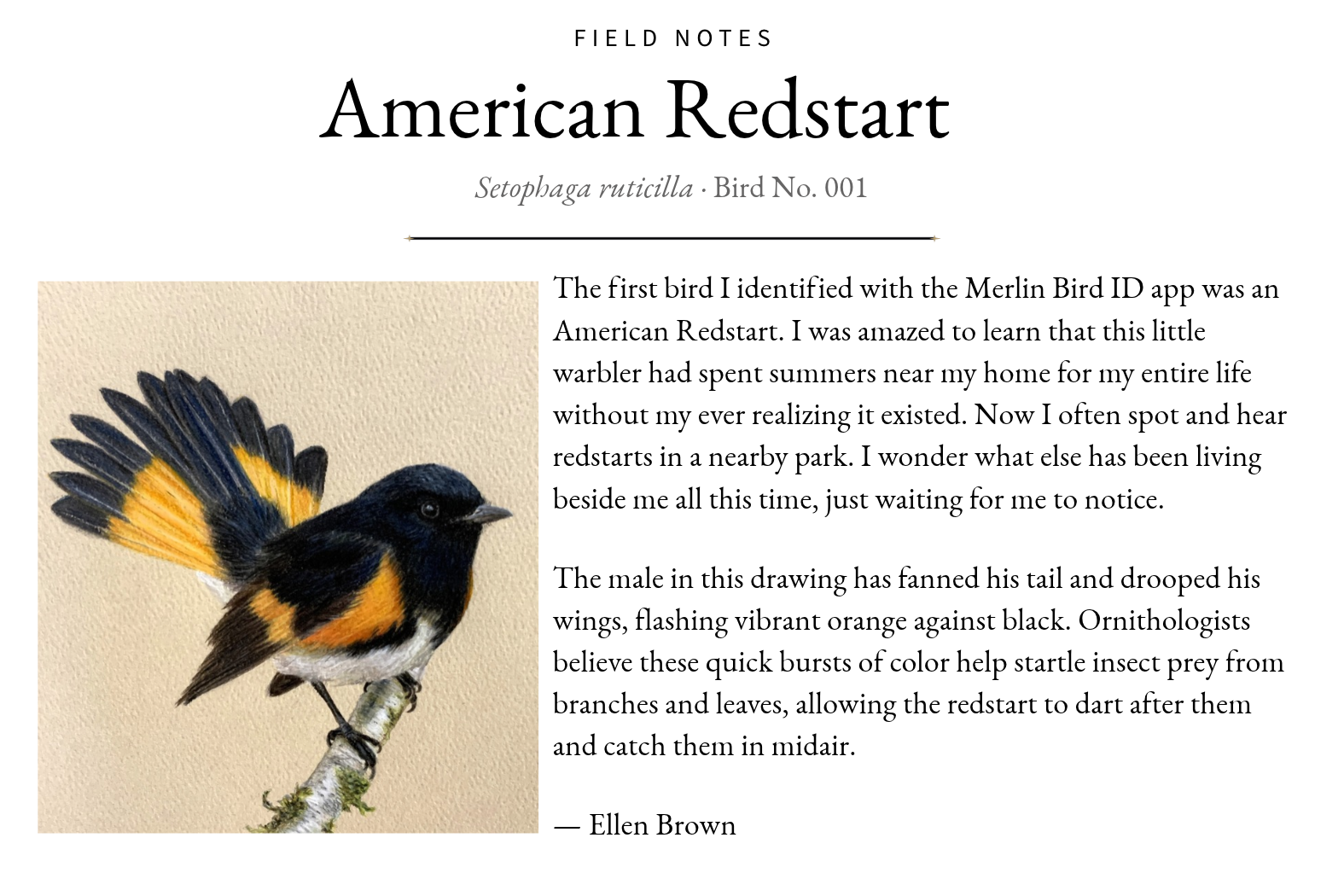
Each original in my Small Bird Collection comes with a Field Note: a short piece of writing about the bird behind the portrait. It gives me a place to share an observation, a bit of research, or a question that stayed with me while I worked.
I’m a science writer as well as an artist, and I’ve always been interested in the space between what we see and what we know. You can recognize a bird by its markings and still have much to learn about how it lives. You can read about a species and then meet one outdoors that surprises you. Looking and learning keep changing each other.
The Field Notes grow from that curiosity. One might begin with a behavior I want to understand. Another might draw attention to a feature that’s easy to miss when a bird is moving through the leaves. They aren’t meant to tell you everything about a species. They offer one way in: something to notice, wonder about, or look for the next time you’re outside.
Writing a Field Note also asks me to make choices. I may have pages of notes by the time I finish a drawing, but there’s room on the card for only a small part of what I’ve found. I look for the detail that brings the bird into focus—the one that makes me want to say, Come and see this.
That’s what I hope the drawing and the Field Note can do together. The portrait lets you spend time with a bird that might have stayed in view for only a moment. The words give you another way to know it.
And perhaps, after you’ve lived with the artwork for a while, you’ll meet its counterpart outdoors. It will probably be busy and gone before you’re ready. But you may recognize a little more than you did before.